.png)
Theory of Mind: Second-Order False Belief
When people talk about Theory of Mind, many immediately think of the famous Sally–Anne Test. That task only measures one part of Theory of Mind known as first-order false belief, the ability to think about another person's mistaken belief from one's own perspective.
In this article, we will talk a more advanced ability called second-order false belief. This requires taking the perspective of a third person, considering what Person A thinks about Person B's belief.
Let's look at a classic story known as the Ice Cream Van Task. You can try answering the question yourself, and parents may also test their children.
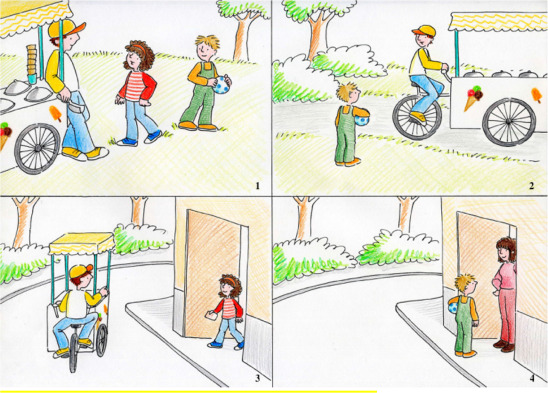
Picture 1
John and Mary are playing in the park. Mary wants to buy ice cream from the ice cream van, but she does not have any money. The ice cream van man tells her, "Go home and get some money, then come back. I will be in the park this afternoon." Mary replies, "Okay, I will go home and get money and come back later."
Picture 2
John is still in the park. Soon, he sees the ice cream van man preparing to leave and asks where he is going. The vendor says, "There are only very few people here, so I am going to sell ice cream in front of the church."
Picture 3
While heading to the church, the ice cream van passes Mary's house. Mary happens to meet him and asks where he is going. The man tells Mary: "I am going to sell ice cream in front of the church."
Picture 4
Later, John goes home from the park. After lunch, he begins doing his homework but encounters a difficult question, so he decides to ask Mary for help. When he arrives at Mary's house, he meets Mary's mother at the door. She tells him, "Mary just went out. She said she was going to buy ice cream." John then goes to look for Mary.
Question: Where will John look for Mary?
The answer is...
The park.
Even though you know that both John and Mary now know the ice cream van is at the church, you also understand something important: John does not know that Mary met the ice cream vendor on the way and learned about the new location. Therefore, from John's perspective, he will still believe that Mary thinks the ice cream van is in the park, and that is where he will look for her.
It sounds quite complicated, doesn't it? Surprisingly, research by Josef Perner and Heinz Wimmer shows that many children around the age of 6-7 are already able to answer this question correctly (Perner & Wimmer, 1985).
Reference
Perner, J., & Wimmer, H. (1985). "John thinks that Mary thinks that…" attribution of second-order beliefs by 5-to 10-year-old children. Journal of experimental child psychology, 39(3), 437-471.
.png)
.png)
Search
Recent Posts
- Understanding Glue Ear in Children
- Newborn Hearing Screening: Passed, Yet Hearing Loss
- Reading Between the Lines: Why Figurative Language Can Be Tricky for Autistic Children
- Speech and Language Delays: What Parents Should Look Out For
- Understanding Your Child's Speech: What Predicts Speech Sound Development?
Categories