.png)
Theory of Mind refers to the ability to interpret and infer one's own and others' mental states, including desires, intentions, beliefs, and emotions. This ability is considered a prerequisite for effective social behaviour (Wellman, 1990). In everyday communication, we rely on Theory of Mind to interpret other people's words and actions, predict their thoughts and possible next steps, and adjust our own behaviour accordingly.
For example, if someone is looking around, seems distracted, and responds with very short answers, we may infer that the person is not very interested in the topic or may even feel impatient. Based on this interpretation, we might decide to change the topic, otherwise the person might choose to end the conversation.
The Famous Sally-Anne Test
One of the most well-known experiments related to Theory of Mind is the Sally–Anne Test, developed by Simon Baron-Cohen, Alan M. Leslie, and Uta Frith (1985).
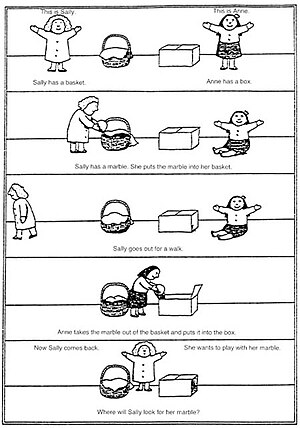
Let's look at the scenario:
- Sally puts a ball into a basket and then leaves the room.
- While Sally is away, Anne secretly takes the ball out of the basket and places it into a box, then leaves the room.
- Later, Sally returns.
Question: Where will Sally look for the ball?
.
.
.
.
.
.
Answer: The basket.
Even though you know the ball is actually in the box, you understand that Sally did not see the ball being moved. Therefore, Sally will believe the ball is still in the basket. This shows an understanding of another person's false belief.
How Children Develop This Ability
Many studies show that most children under the age of four tend to answer incorrectly. Because they saw the ball being moved, they assume that others must know the same thing they know. As a result, they often say that Sally will look in the box.
However, after age four, many children begin to understand that different people can have different perspectives. They realise that what another person believes or knows may not match reality or their own knowledge. This ability is known as first-order false belief understanding, which allows them to correctly answer that Sally will look in the basket.
Reference
Baron-Cohen, S., Leslie, A. M., & Frith, U. (1985). Does the autistic child have a 'theory of mind'? Cognition, 21, 37-46.
Flavell, J. H. (1999). Cognitive development: Children's knowledge about the mind. Annual review of psychology, 50(1), 21-45.
Wimmer, H., & Perner, J. (1983). Beliefs about beliefs: Representation and constraining function of wrong beliefs in young children's understanding of deception. Cognition, 13(1), 103-128.
Wellman, H. M. (1992). The child's theory of mind. The MIT Press.
.png)
.png)
Search
Recent Posts
- Understanding Glue Ear in Children
- Newborn Hearing Screening: Passed, Yet Hearing Loss
- Reading Between the Lines: Why Figurative Language Can Be Tricky for Autistic Children
- Speech and Language Delays: What Parents Should Look Out For
- Understanding Your Child's Speech: What Predicts Speech Sound Development?
Categories