
Emotional regulation plays a key role in children's development. It affects not only their learning and academic performance, but also their social skills, relationships, and mental well-being. However, emotional education is often not a main focus in schools, and many parents may not be sure how to teach it at home.
Today, we're sharing a simple and practical approach developed by Yale University Center for Emotional Intelligence, the RULER strategy, to help children understand and manage their emotion.
1. Recognising – Noticing Emotions
Help your child notice clues about emotions, such as facial expressions, tone of voice, and body language. They can also pay attention to their own physical signals, like a fast heartbeat or sweaty palms. These clues help them recognise both their own feelings and those of others.
2. Understanding – Making Sense of Emotions
Guide your child to think about why they feel a certain way and what might happen next. You can ask simple questions like:
- "What just happened?"
- "Was it what you expected?"
This helps children connect emotions with experiences.
3. Labeling – Naming Emotions Clearly
Encourage your child to use specific words to describe how they feel.
A helpful tool is the mood meter, which helps children identify and label their emotions more clearly. It uses two scales:
- Comfortness (how comfortable or uncomfortable the feeling is)
- Energy (how calm or energetic the feeling is)
These create four colour zones:
- Yellow (high energy, comfortable): e.g. happy, excited
- Red (high energy, uncomfortable): e.g. angry, frustrated
- Green (low energy, comfortable): e.g. calm, relaxed
- Blue (low energy, uncomfortable): e.g. sad, tired
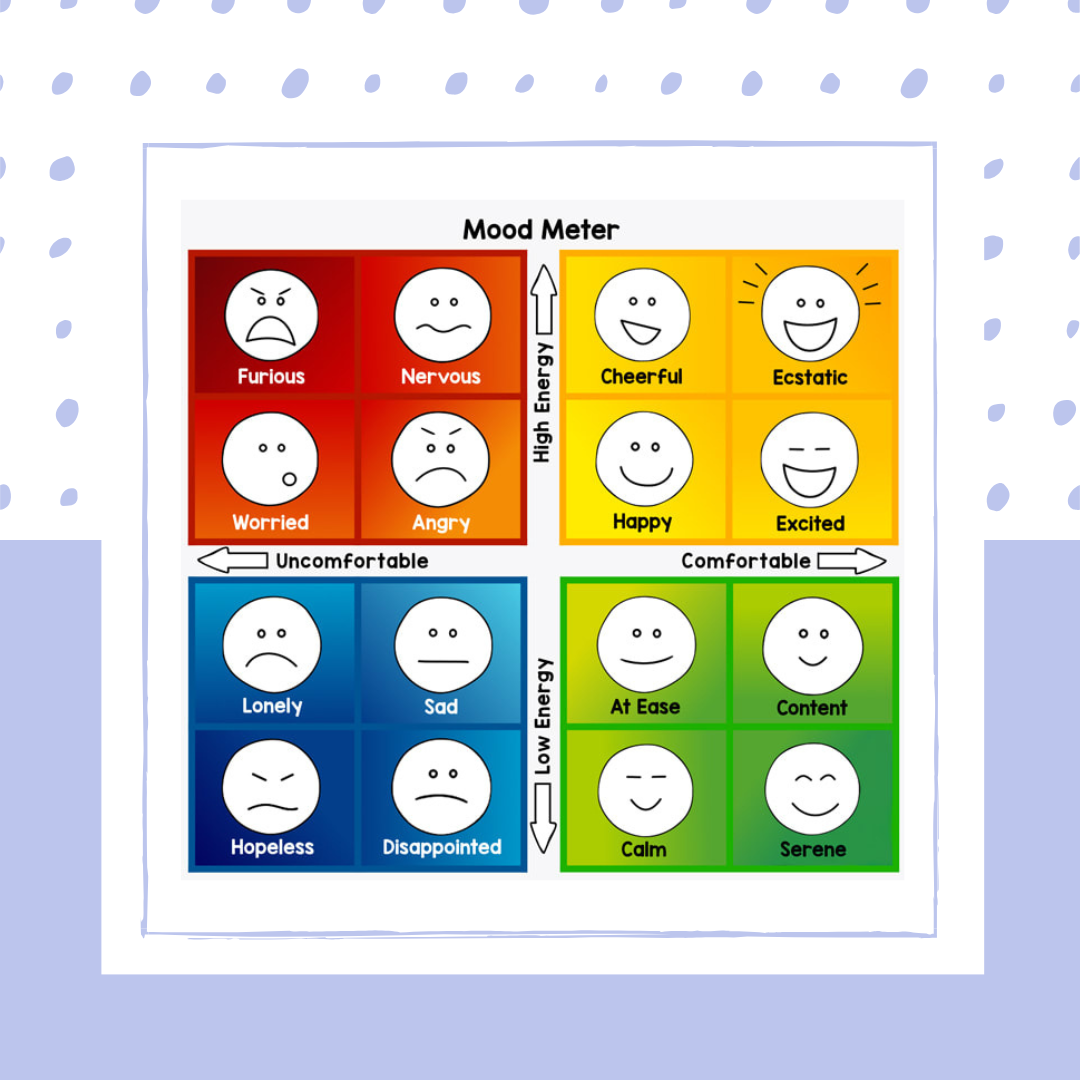
It's important to remember: the goal is not for children to stay in the green zone all the time. Every emotion is valid. What matters is helping them understand and cope with their feelings, no matter which zone they're in.
4. Expressing – Sharing Emotions Safely
Support your child in expressing their feelings in appropriate ways, and listen without judgment. Children may feel angry, sad, or anxious for many reasons. During these moments, they need comfort and understanding. When children feel heard and accepted, they build confidence and feel safe to share their emotions more openly.
5. Regulating – Managing Emotions
Teach your child to pause and calm down using a simple strategy called the meta-moment. When emotions start to rise:
- Pause and take a breath (or count to 10)
- Imagine their best self (this could be a parent, sibling, or role model)
- Ask: What would my best self do in this situation?
- Choose a helpful and appropriate response
Raising emotionally aware children starts with us. Children learn by watching their parents. If we don't talk about our own feelings, they may not feel comfortable sharing theirs, especially during difficult moments. By openly expressing your emotions in a healthy way, you show your child that home is a safe place to share. This also teaches them how to understand and manage their own feelings.
Emotional regulation is a lifelong skill. There's no one perfect way to handle every situation. The key is to guide, support, and learn together with your child, helping them grow into emotionally confident and resilient individuals.
Reference
Hoffmann, J. D., Brackett, M. A., Bailey, C. S., & Willner, C. J. (2020). Teaching emotion regulation in schools: Translating research into practice with the RULER approach to social and emotional learning. Emotion, 20(1), 105.

.png)
Search
Recent Posts
- Understanding Glue Ear in Children
- Newborn Hearing Screening: Passed, Yet Hearing Loss
- Reading Between the Lines: Why Figurative Language Can Be Tricky for Autistic Children
- Speech and Language Delays: What Parents Should Look Out For
- Understanding Your Child's Speech: What Predicts Speech Sound Development?
Categories